Thursday, October 6, 2011

Tripartite Representation: Congressional Representation in Small States, Part I


Wyoming's Congressional Delegation: Who Calls the Representational Dance in Small States?

In preparation for my book on the Montana Senate race, I’ve been doing some reading not only about the American West generally and Montana history specifically, but about representation. The key question driving my interest in the campaign is how two candidates—both of whom represent the same geographic entity—represent the state differently. Political scientist Richard Fenno discusses representational strategies from the perspective of senators and representatives extensively in his public work and I’ve written on this subject in the past (Parker and Goodman 2009; Goodman and Parker 2010). Essentially, Fenno says that members assess the various constituencies within the geographic constituency and use particular groups to build an electoral coalition.

The problem with Fenno is his conceptualization of constituencies began with a study of House members representing one district alone. What happens when the problem becomes one of dual representation—or in the case of small states like Montana—tripartite representation? How do senators and the lone congressman carve up the same geographic, election, and primary constituencies? Do they strive to develop independent representational relationships or do they “ride” on the representational relationships of their colleagues?

Wendy Schiller’s excellent book, Partners and Rivals, provides some answers to this question. According to her research, senators develop their own areas of legislative expertise in developing independent reputations. In particular, Senators from the same party are pushed to differentiate themselves from their senatorial colleague in order to receive attention from the media and develop unique impressions among their constituents. Dr. Schiller looks at an impressive range of data to buttress her findings, looking at the committee assignments pursued by senators, patterns in bill sponsorship and co-sponsorship, and coverage by the local media of Senate delegations.

I’ve decided to put Schiller’s model to work in helping me to better understand the representational dynamics that occur in states where three elected officials represent the same geographic constituency: that is, those states with two senators and only one member of Congress. These states are Alaska, Delaware, Montana, North Dakota, South Dakota, Vermont, and Wyoming. Before adding the wrinkle of House members, let’s first look at the Senate delegations in these states. Do we see a similar pattern in these small states that Schiller finds among all senators—that is, do we see senators attempting to develop distinctive and largely independent legislative portfolios? For this analysis, we are going to look only at Senate delegations from the states above between 2007 and the present. Second, in this first cut, we are going to limit ourselves to examining the committee assignments pursued by the senators. If Schiller is right and the state size doesn’t matter, we should expect to see little if any overlap among the committee assignments pursued among the Senate delegations.

Table 1: Senate Committee Overlap in Small State Senate Delegations, 2007-2011


Table 1 lists the seven states in alphabetical order and the committee assignments among delegations where there is overlap. Note that overlap is exceedingly rare and unusual—a pattern which is similar to what Schiller observes among all Senate delegations between 1988 and 1992. Only in North Dakota do we see overlap, and in the case of Indian Affairs, the overlap is on a minor committee. One caveat is in order: Senate rules prohibit senators from the same party in a state from serving on the same committee (exceptions are made for minor committee assignments). Glancing at the table, four of the six Senate delegations share the same party, so even if overlap were desirable it is exceedingly unlikely to occur.

Given that Senate delegations in small states act very much like Senate delegations in other states, what happens when we add another representative to the mix? Is there this same effort to by the representative to generate a legislative portfolio that’s distinctive from the Senate delegations?

I see two competing hypotheses which could explain the committee assignment decisions of House members where they share the geographic constituency with both senators. First, the Diversity Hypothesis. Even in small and relatively homogenous states there are a diverse range of interests which need to be represented. Members of the House of Representatives, both to represent those issues for the benefit of the state and to carve out distinctive reputations, seek committee assignments to represent those under-represented interests.

Second, the Protection Hypothesis. Small states perceive themselves as particularly vulnerable politically in the chase for federal dollars. Most small states receive more money from the federal government than they pay in federal taxes, but those dollars are always at risk politically from the larger states that lose in this deal. In addition, those federal dollars are especially important in the smaller economies of these states and their loss would get noticed quickly and negatively by constituents. To protect those dollars and the interests of the state, House members are apt to seek committee assignments to “protect” the work and deals made by the senatorial colleagues on their committees.

The Diversity Hypothesis would suggest the House member’s committee assignments will not overlap with the committee assignments of the Senate delegation, and the Protection Hypothesis suggests that the House member’s assignments will overlap to some degree with the Senate delegation in that state. It is important to note that the committee portfolios of senators will always be larger and diverse when compared to House members—both chambers have essentially the same number of committees, but the Senate has fewer members. Senators often serve on six or seven committees, while House members serve on two or three.

Table 2: House and Senate Committee Overlap in Small States, 2007-2011
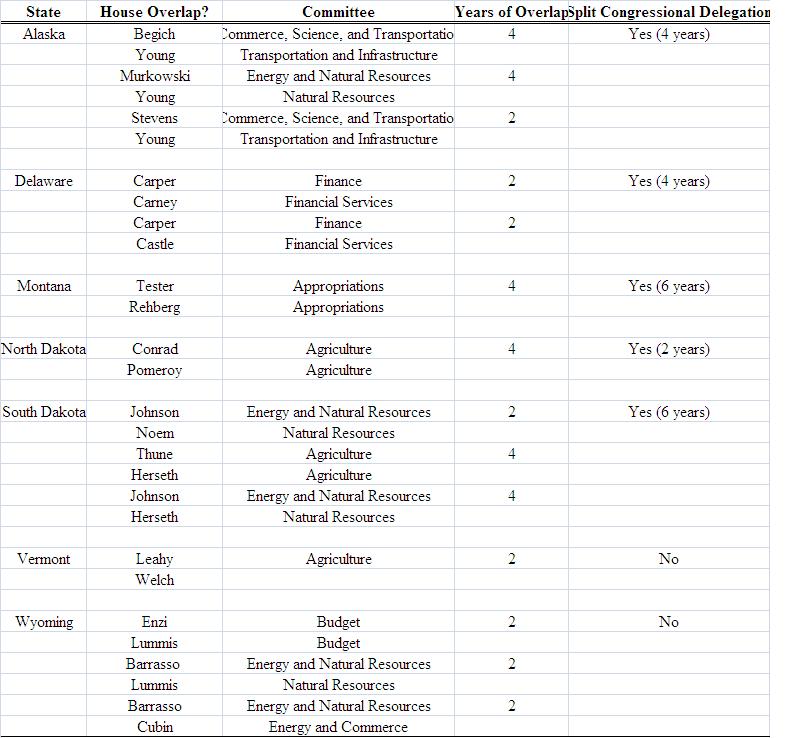
Table 2 lists the committees in each state where the House member overlaps with the Senate delegation. Although the committees are slightly different in both chambers, it is not too hard to identify jurisdictional matches. The first thing you should notice is that while Senate overlap is rare, House members do seek committee assignments which overlap with those of their Senate delegation. The second thing to note is this overlap is often on authorizing committees and not necessarily on prestige committees. This has to do with two key factors. First, it is incredibly hard to get onto a prestige committee in the House. Second, membership on a prestige committee often requires that the House member give up their memberships on other committees—reducing the opportunities for overlap.

Table 2 cannot definitely answer whether the Protection or Diversity hypothesis provide a better explanation for patterns in House committee assignments and their overlap with Senate delegations. In order to provide some hints a relative measure of overlap is required: how much total overlap might we observe in a congressional delegation and how does this maximum possible overlap compare to the overlap actually observed? Table 3 provides a crude measure of this. The measure is crude because, quite simply, the size of committee portfolios is not a constant. Some senators and representatives have many committee assignments, others have fewer—and the patterns differ from state delegation to state delegation. To deal with this, I calculated three statistics for each congress: the percentage of Total Overlap, the percentage of House Overlap, and the Maximum Possible House Overlap. These are described as follows:

Maximum Possible House Overlap: The number of committee assignments held by the House member multiplied by two divided by the total number of committee assignments of the entire congressional delegation. For example, the Alaska congressional delegation collectively hold 11 committee posts in the 112th Congress. The state’s Congressman, Don Young, serves on two committees. If Young’s committee assignments overlap perfectly with the Alaskan Senate delegation, this would create two pairs of shared assignments—which yields a value of four for the numerator and a Maximum Possible House Overlap of 36%.

Total Overlap: This statistic is calculated in a similar manner, but the numerator represents the total number of committee assignments which overlap in the entire congressional delegation. For example, if two senators serve on the same committee and a House member serves on a committee that jurisdictionally matches with one of his Senate colleagues, the numerator would be four (two Senate committee assignments that overlap plus the House member’s committee assignment and the senator’s committee assignment).

House Overlap: Same as above, but the statistic only calculates the committee overlap produced by the House member’s committee assignments. This allows us to quickly evaluate how much of a state’s committee assignment overlap is produced by House, as opposed to Senate, overlap.

Table 3: Measures of Relative Committee Overlap in Small States, 2007-2011

What does Table 3 tell us about representation in small states on committees? First, the data confirm the findings of Tables 1 and 2: committee overlap in small states is largely driven by House members appearing on committees jurisdictionally overlapping with the committees of their Senate colleagues. As Schiller notes, senators do appear to represent the diverse needs of their states and carve out distinctive legislative portfolios. Although there are distinct differences between congressional delegations, the data also seem to provide more support for the Protection Hypothesis than the Diversity Hypothesis concerning the choices made by House members. One third of the time, the Maximum House Overlap and House Overlap statistics are the same value. On only four occasions are the House Overlap values zero, and the rest of the time there is at least some committee overlap between the lone member of the House and her Senate colleagues. This seems to suggest that while the Senate is a place that pushes individual senators even in small and relatively homogenous states to represent a range of interests in their states, House members do not necessarily feel compelled to carve out distinctive reputations or represent other interests that may not be represented by the Senate delegation. One might conclude that the Senate delegation adequately represents the range of interests, but that conclusion is unlikely. Even the smallest states will have interests that go unheard and unheeded in the Senate. More likely, House members in single-member states either hope to “co-op” the legislative accomplishments of the Senate delegation by seeking similar committee portfolios or to demonstrate clout by seeking committee assignments to allow them to receive singular credit for protecting a state’s interests. It might also demonstrate the importance of legislative cooperation necessary for small states to maintain their outsized clout in Washington—a cooperation that is well-understood by representatives and senators representing thinly-populated states that are extra-reliant upon federal dollars.

This post represents my first cut at the question. I welcome feedback, and will continue to explore this issue with additional data in upcoming posts.

Wednesday, September 21, 2011

Everyone's Excited about Elizabeth...

The 2012 Senate elections look exceedingly tough for the Democrats. Maintaining their majority will be difficult largely because they are "overexposed": Democrats need to defend a total of 23 seats--six of them open because of retirements. Many of those seats are held by freshmen elected in 2006, and many are in states that are either swing or decidedly red in their political persuasions. Republicans, conversely, must hold 10 seats--and most of those seats are in fairly friendly territory.


Enter Scott Brown, he who unexpectedly defied the predictions of pundits and captured the Massachusetts Senate seat held for decades by liberal lion Ted Kennedy. If there's a seat Democrats need to pick up--and should--it's this one.


There are lots of things Democrats have going for them. Brown's victory came under unusual circumstances: it was in a special election where voter demographics tend to work in the favor of Republicans, the Democratic nominee--Martha Coakley--was particularly inept as a candidate (she refered to Red Sox pitcher and 2004 World Series hero as "another Yankee fan" and didn't seem interested in doing the spadework of retail politics), and conservative groups were able to concentrate immense amount of resources on this race. Add to this the fact that Massachusetts is--well--MASSACHUSETTS. It is one of the--if not the--bluest state in the country. Obama carried the state by 25 points (making it the sixth best state for Obama), all ten members of the House of Representative representing Massachusetts are Democrats, the Governor is a Democrat, and there are only 32 Republican state legislators in a legislature consisting of 200 representatives and senators total. Add to THAT the fact 2012 is a presidential election year, which should boost voter turnout among Democrats. Both macro- and micro-level trends seem to point to an overwhelming Democratic advantage.


Enter Elizabeth Warren, former Harvard law professor, President Obama's appointee to create a Consumer Protection Bureau, and now candidate for the U.S. Senate seat held by Republican Scott Brown. Several of my Facebook friends excitedly point to a recent poll taken less than a week after Warren announced her decision to run which shows her taking a narrow lead over Brown (see here). Liberals are thrilled--she's very popular among the base and she can raise loads of cash, according to another friend of mine. Scott Brown will be consigned to the dustbin of history, right?


Not so fast, folks. I am not convinced that Elizabeth Warren is all that and a bag of chips as a Senate candidate. To be blunt, she's an amateur--she's never held elected office, knows nothing about retail politics, and--despite her "super-star credentials"--is not what I would call a quality candidate as political scientists define the term. She's not even what I would call an ambitious amateur. She doesn't have widespread name recognition, she doesn't have (as far as I know) a huge source of personal wealth to draw upon, and she's never even run for office before. These are exactly the types of candidates that are prone to make mistakes and underwhelm the electorate once they are placed under the harsh glare of the media spotlight.


But what about candidates like Ron Johnson, who came out of nowhere to beat incumbent Senator Russ Feingold? Lightening can strike--but it does so infrequently. Feingold had never really built a deep and enduring connections to voters in Wisconsin and was highly polarizing due to his iconoclast ways. Brown has some assets, too, that are worth noting:


1. His job approval ratings are tepid, but Brown has strong favorability ratings (above 50 percent according to the PPP poll referenced above). If Brown can focus on his personal characteristics and get folks to either forget or downplay his partisan affiliation, this bodes well for him.


2. He can argue that he'll be in the majority party given the Republicans have a fair shot at retaking the majority, and Massachusetts will benefit from having a Republican senator in that majority representing them.


3. While Scott Brown is certainly to the right of the Democratic-leaning electorate in Massachusetts (see this plot of member ideology relative to state ideology at Voteview), he's certainly one--if not THE--most liberal Republican in the Senate. At least, work done by Professor Royce Carroll at Rice University using current voting records demonstrates this is the case (see this plot of Scott Brown relative to other Republicans in the Senate here).


4. If Scott Brown is so vulnerable, one might wonder why so many other experienced and capable Democratic politicians with actual records took a pass on the Brown race. This includes the entire congressional delegation with such capable individuals like Barney Frank, Stephen Lynch, John Tierney, Ed Markey, and Michael Capuano. And don't forget Congresswoman Nicki Tsongas, who has the valuable asset of a well-known and respected last name in addition to her own work in Congress since she was elected in 2006.


Scott Brown is an experienced politician who's run for office before, understands how to put together a successful campaign, and has defied the odds before. He should not be written off. I am not convinced that Elizabeth Warren is the formidable candidate some claim she is. Her "surge" in the polls is likely attributed to the fact that she has a "D" after her name and simply reflect the partisan advantage any Democratic candidate in a state as blue as Massachusetts would enjoy. Once the campaign begins in earnest, we'll see whether she's truly the top-tier recruit national Democrats would have us believe.

Wednesday, September 14, 2011

Community Resiliency and the Built Environment: Innovations and Policy Issues in Montana

From the Editor: I am posting this blog below for my colleague, Paul Lachapelle. --Dave Parker

As an MSU Extension Faculty member in the Department of Political Science and housed in the MSU Local Government Center, my responsibility is to provide Montana citizens with unbiased, research-based university information and resources on a host of community development issues. An issue facing many communities is how to address their built environment needs and demands. The built environment refers to the human-made physical structures and supporting infrastructure that provide the setting for human activity. In Montana, these surroundings shape our economic, social, environmental, and public health outcomes.

As Editor of the Montana Policy Review, we have devoted our latest issue, Vol. 15, No. 2, titled, Community Resiliency and the Built Environment: Innovations and Policy Issues in Montana to this important issue. With so many community resiliency and built environment policies, programs and projects, we felt it important to highlight the many innovative initiatives currently being designed and implemented across Montana. Citizens and local government leaders from all types of communities—from urban to rural to tribal—want to achieve the best possible outcomes while making the most effective use of limited resources. Policy decisions regarding transportation, land use, and community design influence many aspects of daily living: the distances people travel to work, school, parks, shops, and other destinations; the choice of transportation and housing options; the convenience of purchasing (or growing) healthy foods; the safety and attractiveness of neighborhoods for active living; and the economic and environmental resiliency of the local economy and place.

In Montana, there are many unique case studies that showcase how the built environment influences quality of life and economic prosperity. This issue of the Montana Policy Review presents a series of articles on this topic and identifies best practices, policies and strategies to help communities build safe, healthy and resilient places. In the 13 articles, you will read about community resiliency and the built environment from the people who coordinated or actively participated in all or many facets of the community programs and initiatives. With personal insights and professional learning and wisdom, the stories, narratives, and academic pieces provide the most complete analysis to date of built environment initiatives in Montana from the people who have designed, developed, and delivered the programs and plans. The first few articles present an overview of specific programs related to mapping, master plans, and related land use planning that provides a vision and framework for healthy active communities; these are followed by a set of articles examining issues associated with building and maintaining parks and trails in, near or connecting communities as an economic development and public health strategy; next are a set of articles on the role of transportation in building safe, healthy, and resilient communities with specific case examples of the processes and policy outcomes affecting people and places in the state; the last two articles provide insight on the economics of the built environment with tools and techniques for planning for and funding community initiatives.

In addition to printed to copies, we offer this issue on-line so that readers can click web links, view and download maps and pictures, and disseminate the publication to a far-wider audience than possible in the past. Go to: www.msulocalgov.org/publications to download this current issue. For more information about the Local Government Center or the MSU Extension Community Development Program, please contact me at commdev@montana.edu

Paul Lachapelle, Assistant Professor

Department of Political Science

Wednesday, August 31, 2011

Have Members of Congress become...Ferengi?

The Ferengi Bartender Quark from Star Trek: Deep Space 9

Played by Armin Shimerman


One of the many misperceptions about members of Congress is that congressional recesses are playtime for politicians. Nothing could be further from the truth—particularly the August recess. Members spend much of August travelling their districts and states getting feedback from constituents. Officially, the recess is known as a district or state work period. Members hold office hours, work on constituent problems, and often hold town hall meetings with the public to get their thoughts and feedback. This is an essential part of the representational connection, and is essential to legitimacy in a republic. Both Senator Tester and Congressman Rehberg have been travelling Montana in August to connect with their constituents. And both come back to the state often even when Congress is in session to stay in touch with the folks back home.

Imagine my surprise when I read this article in the Politico, which notes that some members of the House are not holding any public town hall meetings with constituents during the August work period. Even more shocking is the fact that these same members are participating in events where the public can attend and ask questions in a face to face format FOR A FEE. Other outlets have picked up on this (see related stories here, here, and here, and here, and at least one member--after public outcry--agreed to hold an open town hall meeting with his constituents (see here).

Yes, that’s right. You can have access to your member if you are willing to cough up some dough.

One of my favorite television shows is Star Trek—in particular, Deep Space 9. One of the main characters in that show, Quark, belongs to a race of uber-capitalists called the Ferengi. The Ferengi developed a culture that makes Ron Paul’s version of the free market look overly regulated. Everything--and I mean everything—has a price for the Ferengi. You want a government regulator to look the other way? Pay a bribe. If you want to visit a friend in their home, you are expected to pay a fee. The Ferengi society is governed by a series of dictates collectively known as the Rules of Acquistion that help guide individual Ferengi to great profit. There are 286 rules. Here are a few:

Rule 1. Once you have their money--never give it back.
Rule 21. Never place friendship above profit.
Rule 98. Every man has his price.
Rule 285. No good deed goes unpunished.
(Source: The DS9 Encyclopedia,

So, if you want to see your Member of Congress, pay first--up front. In a world where even basic customer service requires a fee, it is sad to see our democratic process become so debased and disconnected from reality. This is certainly not something the Founders ever intended. It would seem that some members of Congress are more interested in learning the Rules of Acquisition than attending to their solemn responsibilities as representatives to meet and learn from the voters who put them in office.

But what is even worse, in my view, is the cognitive dissonance members avoid when walling themselves off from their constituents. Individuals prefer to avoid conflict and opposing viewpoints because it upsets their own personal worldview. The last thing we need is to have members become deaf to the voices of dissent among the folks back home. To use the words of E.E. Schattschneider, the scope of conflict needs to be broadened in politics, not narrowed. Otherwise, policy decisions and outcomes will be made by a select few and not necessarily in the best interest of the whole and of the constituency.

Members who refuse to listen to the voice of the voters and their constituents are not only cheating their constituents, they are cheating themselves. The good news? Voters have an easy remedy at their disposal for members who refuse to engage their constituents come November 2012: the ballot box. And that's a message that any member will be able to hear--constituent town hall or not--loud and clear.

Friday, August 12, 2011

Polarized America--or not.

Read this interesting piece in The New York Times on the August recess and visits members of Congress are having with their constituents. Read it here.

Are Americans polarized like the representatives and senators who represent them in Washington? Recent research suggests, no, they are not. See Professor Morriss Fiorina's work as perhaps the most complete and accessible of the genre.

But here's the kicker. Americans may not be polarized, but the voices of moderation from the middle--the independent voters--may not be heard by those serving in Washington. There's an amazing bit of self-selection going on when it comes to writing their member and showing up at neighborhood meetings with them. Psychologically, individuals try to avoid what is known as cognitive dissonance, which simply means they do not want to have their views challenged and will dismiss information not consistent with their pre-exising views. People who disagree with their members simply stay away. More often than not, members of Congress are preaching to the choir at these gatherings and not really being challenged on their positions.

The moderates--the independents--tend to be less engaged politically. They tend to vote less. They participate in political routines less. The public may not be polarized, but those who engage in the political debate tend to be. The long and short of it is this: until the great middle decides to show up, it is unlikely that the tone and tenure of the political debate will change. Compromise is a dirty word to the ideologically committed.

Unfortunately, politics is--by definition--compromise. The Constitution itself is perhaps the best example of compromise in American politics.

Here's my plea: if America is truly about moderation and compromise as Fiorina's research suggests, then independents and moderates need to start showing up and engaging your members of Congress--or you will never get the change you want. And to those who are on the left or the right, try engaging in folks from the other side of the aisle. If you're a liberal, read The National Review. If you're a conservative, give The American Prospect a try. Never be afraid of ideas. Engage!

Tuesday, August 2, 2011

An Observation by Hunter S. Thompson

Over thirty years ago, the astute political observer Hunter S. Thompson wrote: “One of the basic laws of politics is that Action Moves Away from the Center. The middle of the road is only popular when nothing is happening.” Well, something is happening or happened in Washington politics today and President Obama’s ratings are on the downswing. It isn’t because he is leading and so unpopular – quite the opposite. It is because while he played chess with the Republicans in Congress, they were playing hardball to win. Chess is not a game in which you lead – even if it is multidimensional as some of the President’s people claim. Chess takes a careful, often subtle approach – usually too subtle for the opponent to notice. Hardball is played in the dirt and besides strategy, sometimes requires brute strength to hit one out of the park. Chess and baseball have something in common though – both are zero sum games. Winners and losers emerge. The problem with games though is that in the end, no one is really better off for the experience. To misquote UCLA football coach Henry Sanders – winning is the only thing.

The alternative to the zero sum game is a non-zero sum outcome. In these matchups, we can all be winners. We are better off for the experience and hopefully – a synergetic relationship that results in benefits for everyone.

The zero sum/non-zero sum perspective in politics is a dilemma. On one hand, we need a winner in the process – and a loser. A classic zero sum solution. On the other hand, we can’t function as a society when one half stridently disagrees with the other half and no one seems willing to compromise. Traditionally, we look to our political leaders, victorious from a hard fought but substantive election, for affirmation of societal goals hoping that a rising tide will lift all our ships – a non-zero sum solution. It is the difference between Thomas Hobbs’ “war of all men against all men” or Herbert Spencer’s “survival of the fittest” and Robert Kennedy’s There are those who look at things the way they are, and ask why... I dream of things that never were, and ask why not?” The first two are inherently zero sum, the second non zero.

The problem is, of course, modern elections are not substantive in nature and great political ideas are not much discussed. It appears to most outsiders that politics is a game without end, without rules, and where everyone seems to lose. How did we get to a place where party identification defines “the other”. Originally a Hegelian term, Edward Said refers to it as the act of emphasizing perceived differences for use in marginalizing people in power relationships. “Othering” can be done with any racial, ethnic, religious, or geographically-defined category of people; the other is different than us. The vitriolic flack columist Conor Friedersdorf, an associate editor at The Atlantic, caught from supporters of Sarah Palin after he reviewed the movie is a case in point (see comments here). Friedersdorf, a young libertarian, should be a natural ally of Palin. Instead, he was mindlessly castigated by her admirers as an “enemy of the state (of Palin)”. The attack was aimed not to move the political dialogue forward but to put down an insurrection. This is the politics of zero sum.

The debt limit debacle is the most serious case in point. Set aside the weeks of dithering and deal making. A look at the final vote reveals a pattern of…… not much. Long time Senators, those who should represent leadership, voted for and against the bill in no discernable pattern except the competiveness of their seat in the next election, freshmen voted for and against, tea party members – the contemporary protectors of the values of our founders, expressed a mixed voting pattern as well; it seems that TP members exhibit the same flexibility in policy positions as other, less principled politicians. Consistency will only take you so far in politics. Fully one quarter of the Senate found a reason to vote against a deal that will supposedly save the republic from foreclosure by China. We can hopefully look forward to some in depth analysis by David Parker on this site soon.

The recent debate mess is classic zero sum. In this case in particular, as evidenced by a poll from CNN – no one liked watching it and no one feels better. Let’s hope for better as we move into the fall campaign season.