Created and maintained by professors of political science at Montana State University, this website seeks to bring political science analysis to current political events in Montana, the United States, and across the globe. Our aim is to provide nonpartisan analysis and commentary in a political world replete with punditry and partisanship.
The New York Times recently published a piece on the difficulties House members face when running for the Senate. Read it here. The article discusses Congressman Rehberg, and the chief point it makes is given that Americans hate Congress, so why would they select a House member to move to the Senate? The author notes that the dismal rankings Congress receives overall will make it much harder for individual House members to make the move up to the Senate.
As a political scientist, I had three problems with the article.
First, the serving in the House is the single best path to the United States Senate. Looking at the current membership 112th Congress, 46 senators served as a House member as their last job prior to moving to the Senate. No other career path comes close. 13 served in some statewide elected office other than Governor, and another 10 served as their state’s Governor. 10 had no elected office experience at all, 9 served in the state legislature, and 12 had some elected office at the local level. The New York Times underestimates the skills House members obtain and hone during their service which make them strong Senate candidates.
Second, the article presumes that because Americans hate Congress, they hate their own member of Congress. Anyone who has taken my introduction to American politics class should be familiar with the concept of Fenno’s Paradox. Fenno notes that many Americans hate the institution of Congress, but like their member of Congress. The following graph—which I used in a lecture just last week—illustrates the point clearly. Here in Montana, both Senator Tester and Congressman Rehberg have job approval ratings well to the north of the Congress.
Fenno's Paradox: Ratings of Congress and Incumbents in the American National Election Studies, 1990-2008.
Finally, serving in a state as the lone House member is very different from serving in the House from a state with multiple House members. Generally speaking, the key difficulty facing a House member moving from a congressional district to a statewide office is moving from a more politically homogenous political entity to one that is more heterogenous, representing a more diverse constituency. The same rules do not apply, obviously, to House members representing an entire state. Sure, the House is a more partisan political institution and the name of the representative game is slightly different in how Washington Work is approached. But the task of representing a state—in a single-member House delegation—is not entirely dissimilar from serving in the U.S. Senate (but see Richard Fenno's book, When Incumbency Fails, on North Dakota Senator Mark Andrews who, after having served many years in the House, was elected to the Senate in 1980 and lost reelection in 1986).
This is not to say that Congressman Rehberg or Congressman Berg in North Dakota don't have a tough path ahead of them. But that path is not necessarily more difficult because of their service in the House. The conventional political science wisdom would suggest otherwise.
Wyoming's Congressional Delegation: Who Calls the Representational Dance in Small States?
In preparation for my book on the Montana Senate race, I’ve been doing some reading not only about the American West generally and Montana history specifically, but about representation. The key question driving my interest in the campaign is how two candidates—both of whom represent the same geographic entity—represent the state differently. Political scientist Richard Fenno discusses representational strategies from the perspective of senators and representatives extensively in his public work and I’ve written on this subject in the past (Parker and Goodman 2009; Goodman and Parker 2010). Essentially, Fenno says that members assess the various constituencies within the geographic constituency and use particular groups to build an electoral coalition.
The problem with Fenno is his conceptualization of constituencies began with a study of House members representing one district alone. What happens when the problem becomes one of dual representation—or in the case of small states like Montana—tripartite representation?How do senators and the lone congressman carve up the same geographic, election, and primary constituencies? Do they strive to develop independent representational relationships or do they “ride” on the representational relationships of their colleagues?
Wendy Schiller’s excellent book, Partners and Rivals, provides some answers to this question. According to her research, senators develop their own areas of legislative expertise in developing independent reputations. In particular, Senators from the same party are pushed to differentiate themselves from their senatorial colleague in order to receive attention from the media and develop unique impressions among their constituents.Dr. Schiller looks at an impressive range of data to buttress her findings, looking at the committee assignments pursued by senators, patterns in bill sponsorship and co-sponsorship, and coverage by the local media of Senate delegations.
I’ve decided to put Schiller’s model to work in helping me to better understand the representational dynamics that occur in states where three elected officials represent the same geographic constituency: that is, those states with two senators and only one member of Congress. These states are Alaska, Delaware, Montana, North Dakota, South Dakota, Vermont, and Wyoming. Before adding the wrinkle of House members, let’s first look at the Senate delegations in these states. Do we see a similar pattern in these small states that Schiller finds among all senators—that is, do we see senators attempting to develop distinctive and largely independent legislative portfolios? For this analysis, we are going to look only at Senate delegations from the states above between 2007 and the present. Second, in this first cut, we are going to limit ourselves to examining the committee assignments pursued by the senators. If Schiller is right and the state size doesn’t matter, we should expect to see little if any overlap among the committee assignments pursued among the Senate delegations.
Table 1: Senate Committee Overlap in Small State Senate Delegations, 2007-2011
Table 1 lists the seven states in alphabetical order and the committee assignments among delegations where there is overlap. Note that overlap is exceedingly rare and unusual—a pattern which is similar to what Schiller observes among all Senate delegations between 1988 and 1992. Only in North Dakota do we see overlap, and in the case of Indian Affairs, the overlap is on a minor committee. One caveat is in order: Senate rules prohibit senators from the same party in a state from serving on the same committee (exceptions are made for minor committee assignments). Glancing at the table, four of the six Senate delegations share the same party, so even if overlap were desirable it is exceedingly unlikely to occur.
Given that Senate delegations in small states act very much like Senate delegations in other states, what happens when we add another representative to the mix? Is there this same effort to by the representative to generate a legislative portfolio that’s distinctive from the Senate delegations?
I see two competing hypotheses which could explain the committee assignment decisions of House members where they share the geographic constituency with both senators. First, the Diversity Hypothesis. Even in small and relatively homogenous states there are a diverse range of interests which need to be represented. Members of the House of Representatives, both to represent those issues for the benefit of the state and to carve out distinctive reputations, seek committee assignments to represent those under-represented interests.
Second, the Protection Hypothesis. Small states perceive themselves as particularly vulnerable politically in the chase for federal dollars. Most small states receive more money from the federal government than they pay in federal taxes, but those dollars are always at risk politically from the larger states that lose in this deal. In addition, those federal dollars are especially important in the smaller economies of these states and their loss would get noticed quickly and negatively by constituents. To protect those dollars and the interests of the state, House members are apt to seek committee assignments to “protect” the work and deals made by the senatorial colleagues on their committees.
The Diversity Hypothesis would suggest the House member’s committee assignments will not overlap with the committee assignments of the Senate delegation, and the Protection Hypothesis suggests that the House member’s assignments will overlap to some degree with the Senate delegation in that state. It is important to note that the committee portfolios of senators will always be larger and diverse when compared to House members—both chambers have essentially the same number of committees, but the Senate has fewer members. Senators often serve on six or seven committees, while House members serve on two or three.
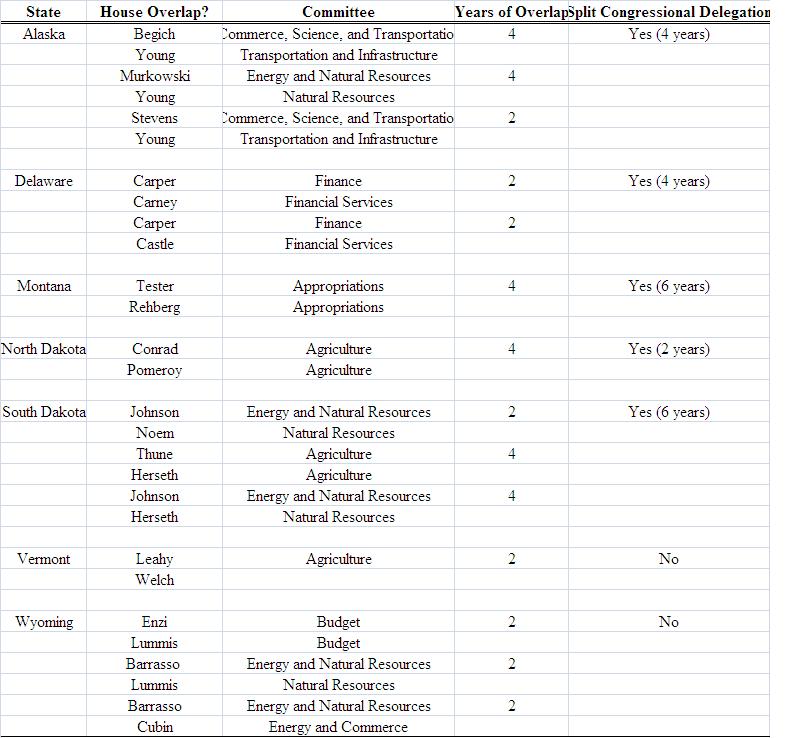
Table 2: House and Senate Committee Overlap in Small States, 2007-2011
Table 2 lists the committees in each state where the House member overlaps with the Senate delegation. Although the committees are slightly different in both chambers, it is not too hard to identify jurisdictional matches. The first thing you should notice is that while Senate overlap is rare, House members do seek committee assignments which overlap with those of their Senate delegation. The second thing to note is this overlap is often on authorizing committees and not necessarily on prestige committees. This has to do with two key factors. First, it is incredibly hard to get onto a prestige committee in the House. Second, membership on a prestige committee often requires that the House member give up their memberships on other committees—reducing the opportunities for overlap.
Table 2 cannot definitely answer whether the Protection or Diversity hypothesis provide a better explanation for patterns in House committee assignments and their overlap with Senate delegations. In order to provide some hints a relative measure of overlap is required: how much total overlap might we observe in a congressional delegation and how does this maximum possible overlap compare to the overlap actually observed? Table 3 provides a crude measure of this. The measure is crude because, quite simply, the size of committee portfolios is not a constant. Some senators and representatives have many committee assignments, others have fewer—and the patterns differ from state delegation to state delegation. To deal with this, I calculated three statistics for each congress: the percentage of Total Overlap, the percentage of House Overlap, and the Maximum Possible House Overlap. These are described as follows:
Maximum Possible House Overlap: The number of committee assignments held by the House member multiplied by two divided by the total number of committee assignments of the entire congressional delegation. For example, the Alaska congressional delegation collectively hold 11 committee posts in the 112th Congress. The state’s Congressman, Don Young, serves on two committees. If Young’s committee assignments overlap perfectly with the Alaskan Senate delegation, this would create two pairs of shared assignments—which yields a value of four for the numerator and a Maximum Possible House Overlap of 36%.
Total Overlap: This statistic is calculated in a similar manner, but the numerator represents the total number of committee assignments which overlap in the entire congressional delegation. For example, if two senators serve on the same committee and a House member serves on a committee that jurisdictionally matches with one of his Senate colleagues, the numerator would be four (two Senate committee assignments that overlap plus the House member’s committee assignment and the senator’s committee assignment).
House Overlap: Same as above, but the statistic only calculates the committee overlap produced by the House member’s committee assignments. This allows us to quickly evaluate how much of a state’s committee assignment overlap is produced by House, as opposed to Senate, overlap.
Table 3: Measures of Relative Committee Overlap in Small States, 2007-2011
What does Table 3 tell us about representation in small states on committees? First, the data confirm the findings of Tables 1 and 2: committee overlap in small states is largely driven by House members appearing on committees jurisdictionally overlapping with the committees of their Senate colleagues. As Schiller notes, senators do appear to represent the diverse needs of their states and carve out distinctive legislative portfolios. Although there are distinct differences between congressional delegations, the data also seem to provide more support for the Protection Hypothesis than the Diversity Hypothesis concerning the choices made by House members. One third of the time, the Maximum House Overlap and House Overlap statistics are the same value. On only four occasions are the House Overlap values zero, and the rest of the time there is at least some committee overlap between the lone member of the House and her Senate colleagues. This seems to suggest that while the Senate is a place that pushes individual senators even in small and relatively homogenous states to represent a range of interests in their states, House members do not necessarily feel compelled to carve out distinctive reputations or represent other interests that may not be represented by the Senate delegation. One might conclude that the Senate delegation adequately represents the range of interests, but that conclusion is unlikely. Even the smallest states will have interests that go unheard and unheeded in the Senate. More likely, House members in single-member states either hope to “co-op” the legislative accomplishments of the Senate delegation by seeking similar committee portfolios or to demonstrate clout by seeking committee assignments to allow them to receive singular credit for protecting a state’s interests. It might also demonstrate the importance of legislative cooperation necessary for small states to maintain their outsized clout in Washington—a cooperation that is well-understood by representatives and senators representing thinly-populated states that are extra-reliant upon federal dollars.
This post represents my first cut at the question. I welcome feedback, and will continue to explore this issue with additional data in upcoming posts.