Showing posts with label Montana. Show all posts

Monday, September 12, 2016

Jesse Laslovich is not a socialist...and I can't believe I have to write this blog


I guess I should be used to folks taking the work that I do out of context. It comes with the territory when you are a scholar engaged in the public realm. Normally, I shrug it off because both sides can be guilty of it. But I take particular exception when the work I do to help inform the public and to elevate the public discourse gets twisted beyond all recognition to score cheap political points that bear no relation to the facts.

Back in the spring, MTN agreed to move Face the State to a weekly format through the election. I thought it would be wonderful to use this opportunity to hold debates on the show for the statewide offices receiving less attention: Auditor, Secretary of State, OPI, Attorney General, and Supreme Court. I reached out to all the major party candidates offering the opportunity to debate. Nearly everyone was excited for the opportunity to share their candidacies with Montana on statewide television.

In late August, Mike Dennison and I taped a Face the State segment with Jesse Laslovich, the Democratic candidate for state auditor. You can watch it here. That segment was supposed to be a debate. We had invited Matt Rosendale, the Republican candidate, to join us. He chose not to attend or offer other dates/times that would work with his schedule, which disappointed us. Laslovich was one of the first candidates to agree to debate back in June. Given Mr. Rosendale’s decision not to debate, we gave Mr. Laslovich the whole half hour to share his vision for the state auditorship with Montanans.

Today, the Montana Republican Party sent out a press release calling Laslovich a “socialist” (I actually laughed out loud when I read this) and, using a clip from our interview on Face the State, intimated that he supports single-payer healthcare as “evidence” of their claim. Mr. Rosendale sent out a tweet with that same clip saying Mr. Laslovich supports more big government to destroy healthcare.

First, Mr. Laslovich did NOT say he supported replacing the Affordable Care Act with a single-payer option. He said our existing healthcare system was still broken despite the positive gains made by the Affordable Care Act, and that the single-payer idea should be taken seriously in any future discussions of healthcare reform. That’s it. He did not say he supported single-payer. He did not advocate for it. He simply said a candid discussion was necessary. 
 
Finally, and this is perhaps the most distressing, single-payer healthcare already exists in the United States and has received support from the Republican Party. It’s called Medicare—you know, that single payer plan providing healthcare for elderly Americans. If single-payer programs are socialist, then any Republican supporting Medicare must be a socialist, too. At least, if we are to simply employ the “logic” expressed in the Montana Republican Party’s press release.

Montanans deserve a fair and vigorous debate between their parties, both of which have different ideas for moving our state forward. That means candidates should debate one another, their views should be publicly scrutinized, and the conversation should be based upon facts rather than distortions. The Republican Party’s characterization of our interview with Mr. Laslovich is simply unfair and mischaracterizes Mr. Laslovich's position. They should issue an immediate retraction and apologize.

Tuesday, April 26, 2016

The True Costs of Denying Public Access: Worse Health Outcomes for the Poor?


Vox had an interesting piece today examining the relationship between income and age expectancy. You can read it here. As one might expect, they report that growing income inequality is related to a growing gap in age expectancy. But there’s another factor seemingly related to how long one lives: Where one lives. Here’s a brief snippet explaining the importance of geography and longevity:

To Chetty's surprise, the strongest pattern in the data was the role geography played: Low-income individuals lived the longest (and had more healthy behaviors) in cities like New York and San Francisco with populations that are, on average, well educated, and high-income.

What leapt out at me, however, was not the connection between urbanity and life expectancy for the poor. Another geographic pattern became apparent as I scanned two charts reporting the life expectancy gap by income in each state: Access to public land. Here are both charts as reported by Vox. The one on the left looks at men; the second, on the right, at women. Click on them to enlarge.


Look at the states clustered at the top: many have substantial public land holdings. Montana is number one for men, and 10th for women. Like a good social scientist, I combined the data in the two charts and added a percentage of total public land ownership variable to the mix. I calculated the longevity gaps between the richest 25 percent and the poorest 25 percent of men and women. Finally, I ran a quick correlation between the gaps and the public land variable. The resulting correlation statistic is simply a measure of how well the two measures move together and in which direction. Here’s a screen shot of the results:


The correlation is negative and statistically significant for men and women, suggesting that the more public land in a state, the lower the longevity gap between the richest and poorest quartiles regardless of gender. Further investigation uncovered that the gap between the poorest 25 percent and the second poorest 25 percent also decreases significantly with greater percentages of public land, but the correlation is less strong (-.30 and -.33 for men and women, respectively, versus the -.47 and -.43 reported above).

It’s hard to make too much of this relationship, as I have not controlled for a whole host of other demographic and behavioral factors that explain health outcomes. Until I’ve done that, it’s hard to see how strong the effect of public land access is on public health outcomes and whether it withstands controlling for these other factors. Correlation is not causation. People who value public land access are very likely different in many respects from those who do not. Certainly, people who move away from a place without much public land in favor of a place with lots of public space are probably going to have different habits and leisure activities than those who stay put. And places with public land are also quite different from places without. Without examining all of these factors, the relationship between life expectancy and public land access is not completely clear.

With those caveats made, an important finding mentioned in the VOX article is the association between poverty and two key factors associated with lower life expectancy: obesity and sedentariness. Clearly, greater access to the great outdoors would help combat both—and this access may be even more important for the poorest among us to increase their life expectancy. Providing and protecting access to public land might be one of the best ways to mitigate one the most dire consequences of rising income inequality.

Monday, August 17, 2015

Hate Forest Fires in Montana? Then Let's Overcome Cognitive Dissonance and Address Root Causes


Summer is my favorite time of year in the Gallatin valley, perhaps because it is so fleeting (which makes it ever-so precious). I hike, bike, and run about town in the wonderful sunlight, surrounded by blue skies and hot, dry heat.  Of course, this weekend, my beloved Bozeman has been choked with smoke from a wildfire out in Three Forks. One of the costs of living in Montana, and the West more generally, is the fire season which is so essential to life and renewal here. Of course, that fire season has been getting worse and longer, which makes it harder on me when I exercise outside due to my asthma, a condition I've learned to manage throughout my life.

Over the weekend, I had time to reflect on forest fires and how sound public policy might help bring them under some control. I revisited Senator Daines’ recent op-ed in the Billings Gazette discussing wildfire and forest reform, which I read with interest. First, Daines hits the nail on the head concerning a critical challenge facing the US Forest Service and other federal agencies responsible for managing healthy forests: money. The US Forest Service’s budget is burdened with ever-increasing fire-fighting costs, which drain its ability to spend on other important activities such as trail, campground, and facility maintenance. Daines’ solution to this problem is his Wildfire Disaster Funding Act “which ensures large forest fires are treated and funded as the true natural disasters they are, similar to hurricanes or tornadoes.” I hope the bill—which Daines is co-sponsoring along with Senator Tester—finds a solid reception among critical allies of both parties, particularly those senators representing East Coast states hard hit by Hurricane Sandy. (Montanans also should hope that they don’t hold then-Congressman Steve Daines’ very first roll calls against him, given that he voted against a bill funding Sandy relief efforts.)
But what troubled me profoundly was the blame the senator placed for the “deteriorating conditions” that are responsible for increased wildfire risk. Senator Daines notes that we are at risk due to beetle kill in our forests “being left untreated”—a risk that he says is compounded by “years of inadequate forest management practices, spurred by obstructionist litigation from fringe groups and excessive regulations.”
Really? Well, I guess it’s time for me to whip out some “fancy” social science and give a little lesson in the funnel of causality. This is a theory developed by Campbell et al in their path-breaking work The American Voter, published in 1960. Essentially, Campbell et al argue that while the proximate decision influencing how someone votes is a person’s issue position, those issue positions are the product of a person’s party identification, which itself (often?) is a function of how the person was socialized into politics by his or her parents.
In other words, there’s a causal chain one needs to follow to understand the best and most powerful predictor of voting behavior, and that predictor is partisan identification—a bundle of attitudes and beliefs that is not immediately proximate to the voting decision. Issue positions don’t really matter—it’s the partisanship behind those positions that do.
Now let’s apply the funnel of causality to Daines’ argument on wildfires: According to his op-ed piece, the proximate causes for the risk we face, which are the tired trope of “government mismanagement” and “fringe environmentalists,” are the real problem Montanans face and the ones that require attention and redress.
But one must ask: Why is there more beetle kill in the first place? And why has the size of wildfires been on the rise in the United States, Canada, and globally—both as the charts below indicate and a recent study demonstrated? Oh, right: Because the warmer winters associated with global warming mean fewer Pine Bark beetles are dying off, enabling them to leave behind more dead trees strewn about waiting to burn up. All of this is well-documented Andrew Nikiforuk’s Empire of the Beetle. And, again, a recent study demonstrates that increasing temperatures lead to more wildfire activity globally.
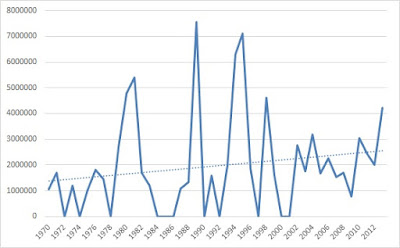
Total Hectares Burned by Wildfires in Canada, 1970-2013. Source: Canadian National Forestry Database

Total Acres Burned in the US (in millions of Acres), 1960-2014. Source: CRS Report, "Federal Funding for Wildfire Control and Management," July 5, 2011 and National Interagency Fire Center.

Daines is giving far too much credit to proximate causes: lawsuits and mismanagement. The root problem is global warming. We need to address that if we really want to get a handle on our wildfire risk. And to address that we, as global citizens, need to come to grips with our role in global warming via our insatiable appetite for carbon emissions.
Unfortunately, Senator Daines voted against an amendment earlier this year during the Keystone XL debate acknowledging the human role in climate change and, when running for the House, indicated in an interview a few years ago that the “jury is still out” on the role of CO-2 emissions in our ever-warming world.

The jury is not out. Ninety-seven percent of studies unambiguously endorse the notion that rising carbon dioxide levels, the result of human activity, are an important and substantial contributor to global warming. Check out the information yourself at NASA.
 
How many of you, when running a business or a household, place your bets on the 3 percent versus the 97 percent? If Senator Daines did this during his business career, I assure you, his career would have been much shorter and far less successful than it was. If I said it is only a "theory" that how people vote is a product largely of their partisanship, I'd be drummed out of the profession with good cause. The problem is that it is very hard for people to accept information that conflicts with their priors. Humans don't like cognitive dissonance, so instead, we reject information when it doesn't fit our beliefs. Worse, we search for justifications to confirm why that information is wrong and why what we believe is right. It is hard to overcome cognitive dissonance, but we--and those whom we elect to serve us--must.

The senator is a bright, articulate public servant. He is a graduate of Montana State, and has a degree in engineering. One would think that he would, as a man of science, make public policy on science and not advanced smoke-and-mirrors arguments about a very real threat our forests face from wildfire. How we fund fire fighting absolutely must change: Daines is right on that. But if we are really going to make our forests safer today and for future generations, we need to stop blaming red herrings and, instead, face the facts staring us straight in the face with regards to climate change.

Saturday, October 25, 2014

Mailergate: A considered response

The folks at the Western Political Science Association are re-branding their blog, the New West. And yesterday, a professor who does field experiments posted a thoughtful reaction to the Stanford mail experiments in the Wheat-Van Dyke race which has received overwhelmingly negative reaction here in Montana.

I encourage you to read the piece here.


Monday, December 13, 2010

Democrats face big challenges in 2012 here in Montana

A quick piece from Campaigns and Elections Magazine on the challenges Montana Democrats face here in 2012. Read it here.

One quick note: the piece says that Governor Schweitzer is up for reelection in 2012. That's not the case; Governor Schweitzer is term-limited, so the race is wide-open.

Saturday, November 13, 2010

The 2012 Montana Senate Election: It's ON.

Attended Steve Daines' announcement for the U.S. Senate today to help the local television with commentary. Daines is a native Montanan, and co-founder of RightNow technologies--one of Bozeman's major employers. In reviewing Daines' materials, it's the standard "I'm an outsider, government is too big, and I've created jobs" that one might expect, especially after the success of this type of message in the 2010 midterm elections. In many ways, I suspect the campaign will be similar to Ron Johnson's successful campaign in Wisconsin. Johnson ran against, and defeated, three-term incumbent Russ Feingold.

I was asked if Daines has a chance. Well, of course he does--the question is whether that chance is substantial. In political science, we term challengers as quality or not. Quality is generally defined as having experience in elected office. These candidates generally have the best chance of beating an incumbent--which is a tall order indeed. However, some candidates without elected office experience are classified as "ambitious amateurs" (see Canon 1990). These candidates may not have elected office experience, but they behave strategically like experienced candidates. They generally have decent name recognition and financial resources, and they make the decision to run strategically.

The incumbent senator, Jon Tester, is running in his first reelection campaign. The best chance of beating an incumbent is when they run in their first reelection campaign. So, if Tester is to beaten, this is the time to do it. Daines is acting strategically by choosing to take Tester on now. And, he's acting early enough to get his name out there and to clear the field of other prospective challengers.

Daines narrative is might compelling in an environment with high unemployment and discontent with incumbents. He's certainly taps into the Tea Party skepticism of larger and bigger government. Tester, of course, can be tagged with some unpopular votes.

Tester, however, has other advantages that should not be dismissed. He is the incumbent. He is a native Montanan. He is a rancher and a farmer. He is pro-gun and a conservative Democrat. It will be hard, methinks, to paint him as an Obama/Pelosi Democrat. And the election is two years away. The economy might improve--and the electorate voting in 2012 will be very different from the one turning out in 2010. All of things bode well for Tester in defending his seat.

Nevertheless, if Daines is the nominee, we can expect a lot of money to be spent by both sides in 2012. Lots of television ads, lots of voter outreach--a rich information environment to help reduce the costs of voting and get more people involved/interested. I can't wait to watch this unfold.

Monday, January 12, 2009

A lesson in correlation and causation

One of the foundational texts in voting behavior is the American Voter, published in 1960. This book kick-started the behavioral revolution in the discipline, moving political science away from the study of institutions and legal systems to the examination of individual political behavior.

Campbell et al discuss in the early chapters of the book the funnel of causality. To use their words directly:

"Events are conceived to follow each other in a converging sequence of causal chains, moving from the mouth to the stem of the funnel. The funnel shape is a logical product of the explanatory task chosen. Most of the complex events in the funnel occur as a result of multiple prior causes. Each such event is, in its turn, responsible for multiple effects as well, but our focus of interest narrows as we approach the dependent behavior. We progressively eliminate those effects that do not continue to have relevance for the political act" (p. 24).

What causes someone to vote in a particular way? Lots of things. But the best predictor--the most causally proximate--would be partisanship. It is the best single predictor of political behavior.

I mention all of this in the context of a news story I saw floating about on the web the other day. Apparently, traffic fatalities in Montana were down in 2008, compared to 2007. The reasons offered included increased use of seat belts and more police patrols. And yes, these probably do relate to the decrease in traffic deaths. But are these factors the most causally proximate predictors of the observed behavior (i.e. a decrease in traffic fatalities)? Probably not.

I was surprised that the article did not mention the most likely reason for the decline: fewer highway miles travelled. This, from a press release generated by the US Department of Transportation:

"Americans drove more than 100 billion fewer miles between November 2007 and October 2008 than the same period a year earlier, said U.S. Transportation Secretary Mary E. Peters, making it the largest continuous decline in American driving in history." Read the whole release here.

Now, sure, one might say Montana probably didn't experience as big of a decline. Wide open spaces, big distances, there's only so much travel you can reduce in a state as big and as sparsely populated as Montana. Well, wrong. Montana's August 2008 travel numbers suggest that we had between a 5 and 6 percent drop in travel compared to August of 2007. That's among the biggest drops in the country (18 other states were in the top category). Check out these maps here.

The moral of the story: the simplest explanation is probably the best, and correlation does not equal causation.

Thursday, October 23, 2008

You're not voting for McCain or Obama, technically

A few weeks ago, I was sitting in my office doing some work and I got a phone call from what I thought was a reporter. The person on the other end of the line asked me if it's true that we don't really vote for the candidates listed on the ballot. I replied that was correct. Technically, when we cast our ballots in the presidential election, we vote for electors that are pledged to that candidate.

The voice on the other end of the line asked me, "Well, then how do we know that they will vote for the person they are pledged to?"

My response: you don't, and that's the point. The Electoral College was set up as one last check against majority tyranny by the Founding Fathers. When we cast our ballots, we actually cast our ballots for a slate of electors who then cast their ballots for their presidential choice. And they can choose to express themselves however they wish, regardless of their individual pledge to a candidate. Each elector represents one of the state's electoral college votes. In Montana, then, we have three electors that will cast their ballots in December for president. Who wins the popular vote in the state will have the three electors pledged to them cast Montana's electoral votes. This vote total is received by the Secretary of the Senate and that becomes the official election tally.

In case you were wondering, here are the electors pledged to McCain and Obama:


1. Thelma Baker
2. Errol Gault
3. John Brenden


1. Chas Jankier
2. Ann Milbrooke
3. Greg Jerguson


The likelihood of an elector NOT casting their ballot for the candidate to whom they are pledged is quite rare. First, the electors are generally good party members and friends of the candidate. Second, some states have laws that require electors to cast their ballots for the candidate who wins the popular vote in the state (of course, I think these laws are constitutionally dubious but, to my knowledge, they've never been challenged). Montana is one of these states. This suggests, of course, that the check on majority tyranny is no longer a check but a simply constitutional formality ratifying the will of the people.

The last time an elector did not cast their ballot as pledged was in 1976 when one of Gerald Ford's electors cast his ballot for Ronald Reagan.

By the way, the person who called me was not a journalist but a chef. He and his colleagues were simply discussing this while preparing for the lunch crowd, and wanted to know who Montana's electors were.